

Cutting Through Noise to Keep Execution on Track: How We Talk About Change in an AI World
I’ve been paying attention to how we’re talking about change, especially when it comes to AI. Not just what’s happening, but how we explain it… how we justify decisions and make sense of change.
In this environment, clarity becomes a differentiator.
Our New Reality rewards those who can tolerate normal chaos and still help others see what matters, linking it to strategy, performance, and culture.
In this month’s newsletter:
Why some companies are “AI washing” decisions and what that signals
A quick introduction to bubble logic and how it shapes decisions
What it takes to lead through noise without losing execution
AI Washing: Why some companies are taking a bath
You know the adage, 'It’s important to walk the talk?' How about we start off where the talk is walking?
Gautam Mukunda is an Opinion Columnist. In his recent article, The AI Washing of Job Cuts is Corrosive and Confusing (Bloomberg, March 13, 2026), Mukunda writes that “It seems that AI’s role is being emphasized in layoffs because it is viewed more favorably by stakeholders than saying layoffs or hiring freezes are driven by financial constraints.”
Mukunda pulls together these examples:
In June 2025, Amazon CEO Andrew Jassy cautioned employees that artificial intelligence would lead to a reduced workforce at the company.
In October, Amazon.com Inc. fired 14,000 workers with its senior vice president of people citing “transformative technology.”
Yet, shortly after the October layoffs, according to Mukunda, Jassy corrected course, stating: “The cuts were not really AI-driven, not right now at least.” “It’s culture.”
In February, OpenAI CEO Sam Altman admitted that companies are “AI washing” layoffs, blaming artificial intelligence for workforce reductions they would have made anyway.
A National Bureau of Economic Research study published in February surveyed thousands of C-suite executives across the US, UK, Germany and Australia. Almost 90% said AI had zero impact on employment over the past three years.
Challenger, Gray & Christmas tracked 1.2 million layoffs in 2025, and AI was cited in fewer than 55,000 of them. That’s 4.5%. Plain old “market and economic conditions” accounted for four times as many.
What are the advantages? Why the “AI Washing?”
Investors punish companies that frame cuts as a response to problems. “We over-hired during the pandemic and revenue softened” is an accountability signal.
But when a company frames the same cuts as proactive restructuring, the penalty disappears. “We’re restructuring around AI” is a growth signal.
Mukunda says of Altman, “This is not a case of a CEO lying to investors; it’s a case of a company so ensnared by bubble logic that its own leadership couldn’t tell a coherent story about its motivations”.
Bubble, Bubble, Toil & Trouble
So, what exactly is bubble logic? If you don’t know Edward de Bono (1933-2021) he’s the originator of the concept of lateral thinking and logic-bubbles.
A logic-bubble, according to de Bono, “is that bubble of perception and values within which a person is acting." Actions considered within the individual’s logic-bubble seem logical to them.
In the case of “Let’s Blame AI for layoffs” the bubble logic of blaming AI is compelling... because inside the bubble, it works.
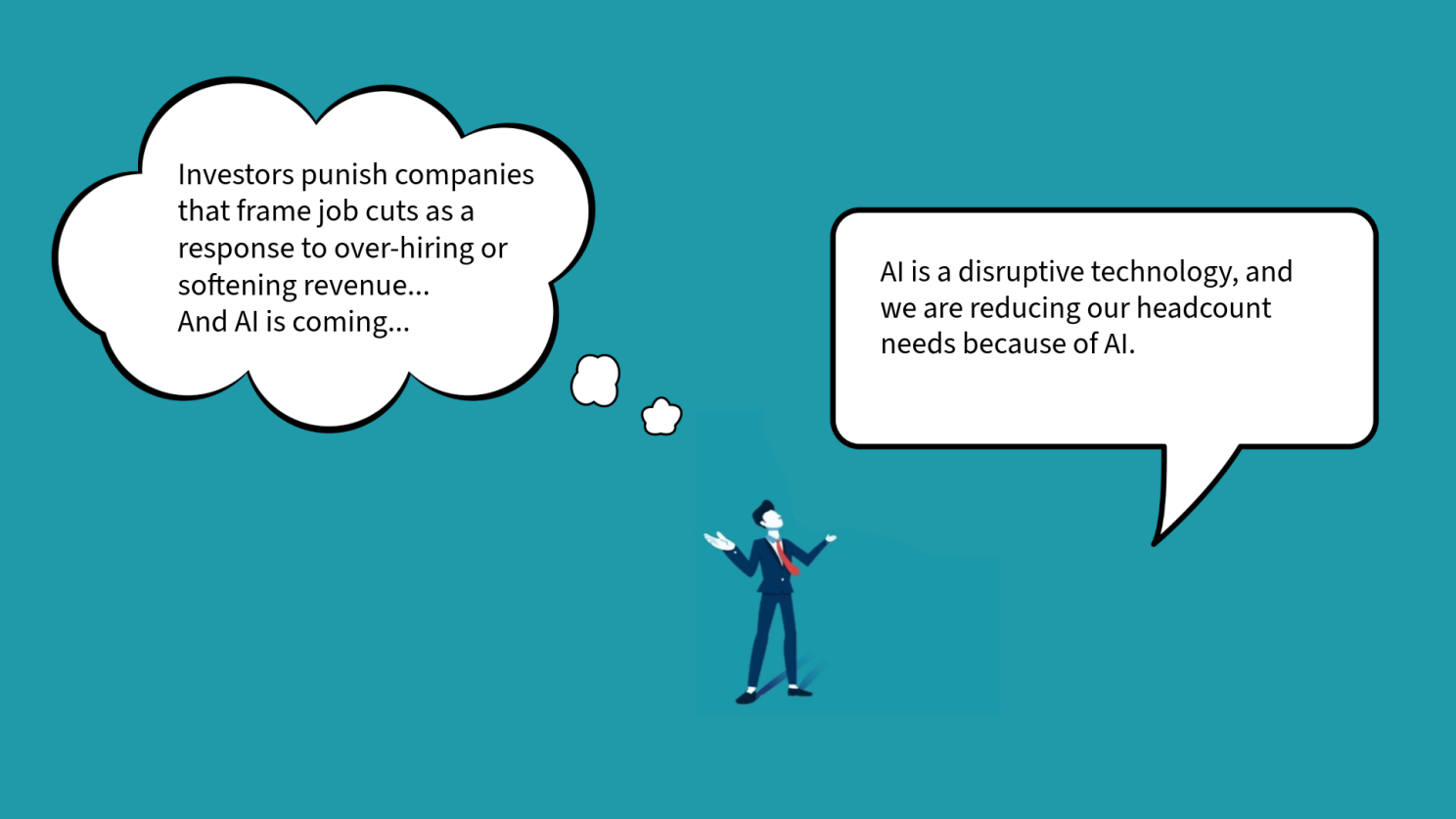
The thinking is… "Well, AI IS what's happening right now."
In that case, the 'bubble logic' perception becomes the story.
Here the talk is walking... and it is corrosive.
The AI premium isn’t even reliable. Mukunda tells us, by late 2025 Goldman Sachs group Inc. found that investors were punishing AI generated layoffs with shares falling an average of 2%. The analysts concluded that investors simply didn’t believe the companies.
So what does this mean for how we lead through it?
Leading through change: Poise and execution are powerful allies
AI creates noise. New tools. New language. New expectations.
I’ve seen leadership teams respond with activity... lots of starts, very little finish. Initiatives launch. Priorities shift. The story changes quarter to quarter. Motion looks like progress. It isn’t.
Avoiding “fits and starts” in a New Reality Transition requires something different.
Poise slows the moment down. It creates space to think clearly. It keeps teams from reacting to noise instead of what actually matters.
Execution moves things forward. Clear sequencing. Defined ownership. Visible progress. Not just deciding what to do, but who will do it, and when.
This is where domain expertise matters.
It's also where the the expertise of executive coaches can be helpful. Organizational design. Change management. Transformative change. The work of developing leaders and teams who can operate under pressure without drifting. (Read more here: The Bound Man)
That work doesn’t compete with AI. It runs in parallel with the people designing and implementing it.
The focus here is on developing Actors in Context.
Leaders. Operators. Teams. Working within a specific moment. Shaped by incentives, constraints, and change.
Because in a world chasing AI, advantage goes to those who can still execute.
Here are a few ways to put that into practice.
Developing a tolerance for ‘normal’ chaos (Yourself & Others)
Be bold. Direct. Hard on issues. Easy on people.
Focus on Distributed Ownership (inputs, ownership & visibility). Everyone knows what they own and what others depend on.
Determine each contributor’s logic bubble. Understand how each person is making sense of the situation and why their actions feel logical to them. (Read more here: Driving the Traffic - Aug 2025)
Capitalize on the diversity of thinking.
Utilize motivation. Challenge people to create something unique or design their future job.
See it. Be it. People move differently when they can see themselves in the outcome.
Design Four Scenarios. Pick three. Then pick one (Formal Future). Create more than a vision. Build a shared, working version of what comes next.
Use team(s) to create MAP to the Formal Future A practical path, how the work actually gets done from here to there. It takes a map. When context changes, behaviors must change and you can’t solve that with generic plans.
Be ready for the unexpected. Transformational change takes people where they didn’t expect to go and that’s why it works. It happens when people are then enfranchised; enabled to discuss and construct a Formal Future (here an AI future).
The tools will keep changing. The narrative will keep shifting. The work is staying grounded in context — and moving forward with clarity and intent.